



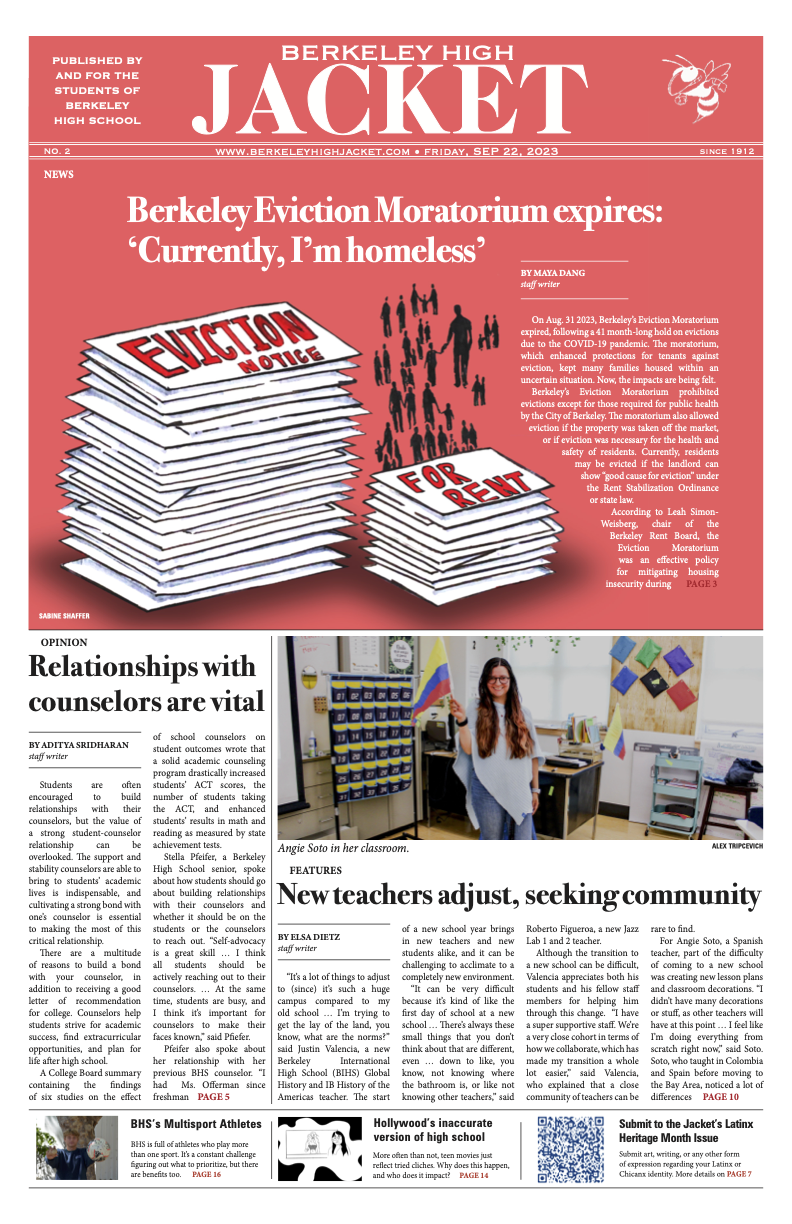

Suzanne Collins’ book series, “The Hunger Games,” takes place in Panem, a country where the wealthy Capitol controls the poorer districts and takes advantage of their people. The story follows Katniss Everdeen, a teenager from the poorest district who is forced to compete in the annual “Hunger Games,” where children from each of the 12 districts fight for survival while all the rest of the citizens of Panem watch the televised games for entertainment.
Collins’ literary trilogy criticizes both wealth inequality and the abuse of power. However, with a new movie adaptation being released on Friday, Nov. 20, 2026, notable contradictons have surfaced.
Hollywood has turned the story into a multibillion-dollar franchise, making money from the same culture of wealth and celebrity that the films and books themselves criticize.
For Berkeley High School freshman Olivia Ward, the similarities between Hollywood and the Capitol are hard to ignore. She sees an irony in celebrities promoting a series that criticizes the wealthy lifestyle that many of them are a part of.
“I just think it’s funny when people who read or watch the Hunger Games say things like, ‘Oh yeah this is so real. The message is so true,’ but then they are people who would be in the Capitol,” Ward said.
In the films, Capitol citizens watch the suffering of people in the districts as entertainment, without having to deal with the problems others face. Similarly, audiences today can watch movies about poverty and inequality without thinking about how those issues show up in their own lives.
The amount of money the movies have made adds to the irony. The five released “Hunger Games” films have made more than $3.4 billion worldwide in ticket sales, according to Scholastic. Even though the series criticizes a society built on wealth and power, the films have become part of an industry that makes money from those same things.
BHS freshman Henry Hardcastle-Ross also sees the hypocrisy in the franchise. However, he believes that their success can help the message reach a larger audience.
“Obviously, these are wealthy people who are only going to get wealthier because of the films,” Hardcastle-Ross said, “But in our society, sometimes you need to put a lot of money into something for it to be communicated to a lot of people.”
Yesenia Rodriguez, a BHS English teacher, recognizes that Hollywood helps bring the message of “The Hunger Games” to a larger audience, but she questions how much of that message actually comes across to viewers.
“Hollywood does have a platform, and how people use that — with intention — matters. But the way they’re doing it, it’s really for money grabs and box office money, so it’s not as effective,” Rodriguez said.
While “The Hunger Games” challenges audiences to question inequality and privilege, its message becomes more complicated when you consider the industry behind the films. Recognizing these on screen is one thing, but recognizing them in the outside world is equally important in order to change these issues.