

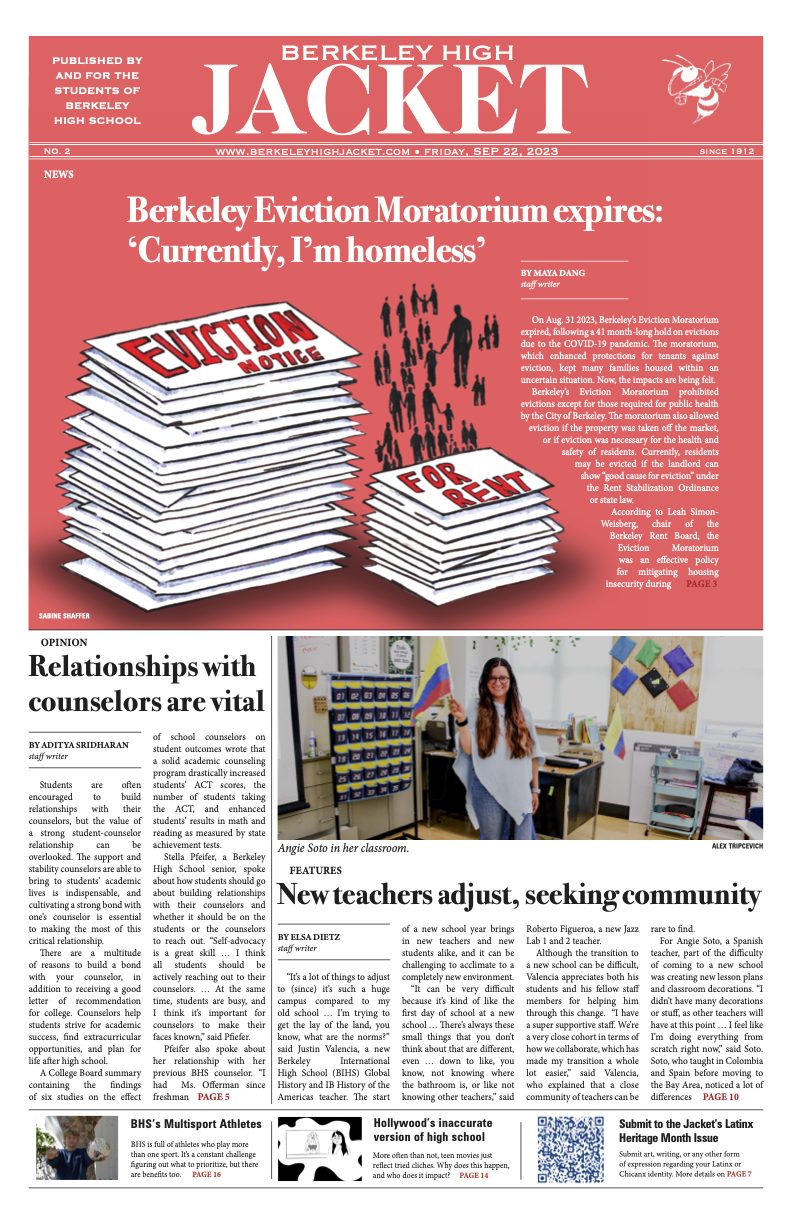

Over 1.5 million families in California spend over 50 percent of their monthly income on rent, according to the California Department of Housing and Community Development. All around the country, many Americans deand more affordable housing.
California is the US state with the highest number of people experiencing homelessness. While Berkeley has tried to implement various solutions, some argue that the main issue is simply that housing is not being built fast, or affordably enough.
In July, California Governor Gavin Newsom passed Assembly Bill 179, which essentially removed guardrails for building more housing and incentivized cities to build more. In recent years Berkeley has seen a wave of planning for the construction of large residential buildings, falling in line with this new state bill and long-standing demand. However, there are two sides to every city construction proposal: although many Berkeley residents are in favor of new building plans, many have taken issues with certain developments. In the past few years, new construction plans have become a particularly controversial topic in Berkeley city politics.
“I think people who don’t want the neighborhoods to change at all are going to be disappointed,” Shoshana O’Keefe, a Berkeley High School computer science teacher and Berkeley City Council member, said,“I believe that they have to change. The city has to grow and has to evolve.”
As the city changes, residents grapple with balancing preserving the old and embracing the new.
Upzoning in the Elmwood District
Elmwood, or more specifically College Avenue, is one of many popular places that BHS students hang out. For Berkeley City Council District 8 representative candidate Michael Wallman, the charming and almost small town feel of College Avenue comes from the independent establishments. “Keeping small businesses thriving (matters), because that’s kind of the heartbeat of the economy,” Wallman said.
The Elmwood upzoning plan would add housing above many of the shops that are currently only two stories, with some proposed additions reaching as high as seven stories. Save Berkeley Shops — a nonprofit organization built by residents and shop owners from around Berkeley — gives out posters and yard signs opposing upzoning in the Elmwood. Many community members, including Save Berkeley Shops, believe that in the time it takes to do this construction, the atmosphere of the neighborhood would completely change. Some shop owners fear they would go out of business as a result of upzoning in the neighborhood.
This fear is partially due to a previous instance of construction promises in Downtown Berkeley on Center St. in 2024. Shops were bought by a Chicago-based developer, but due to high inflation rates and other factors, the project was abandoned. Since then, the spaces for those shops have been boarded up. Some residents are worried that a similar situation could happen in the Elmwood.
Throughout Berkeley there are contradicting opinions on what should be done. “I don’t want to live in a city where there are seven-story apartments that are spun up everywhere,” Wallman said.
Others, like O’Keefe, argue that there needs to be efforts to create more housing in Berkeley. “I am definitely eager for creative solutions that can allow for the added housing, which I do support, and make sure that the shop owners are protected,” O’Keefe said.
600 apartments near Ashby BART
Renderings of the planned housing development on Ashby Avenue and Martin Luther King Jr Way — in the current Ashby BART parking lot — were presented to the public in July, and developers plan to break ground in 2029. The new building plan has “transit-oriented development” in mind, meaning that in addition to 600 apartments, the building’s first floor will have retail space incorporated in.
Initial public concerns were raised about the housing development’s potential impact on the Berkeley Flea Market, which is held in the Ashby BART parking lot every week on Saturday and Sunday.
“A lot of people told us that (the flea market) is a really important asset in the community,” Shannon Dodge, BART’s Principal Property Development Officer, said, “It’s not as big as it used to be, but it’s still a destination and culturally important, especially in the Black community of Berkeley.” The developers plan to extend out a portion of sidewalk out to create a dedicated spot where the flea market could be held.
Many hope that the implementation of increased housing, as well as new space for retail, will bring consistent foot traffic into the Ashby-Adeline area.
“When the BART was developed, it kind of broke the community,” Teresa Clarke, one of the founders and organizers of South Berkeley Now, a volunteer group that advocates for the economic development and preservation of South Berkeley, said. “We’re hoping that (the new housing) will repair some of the damage that was done to the community.”