

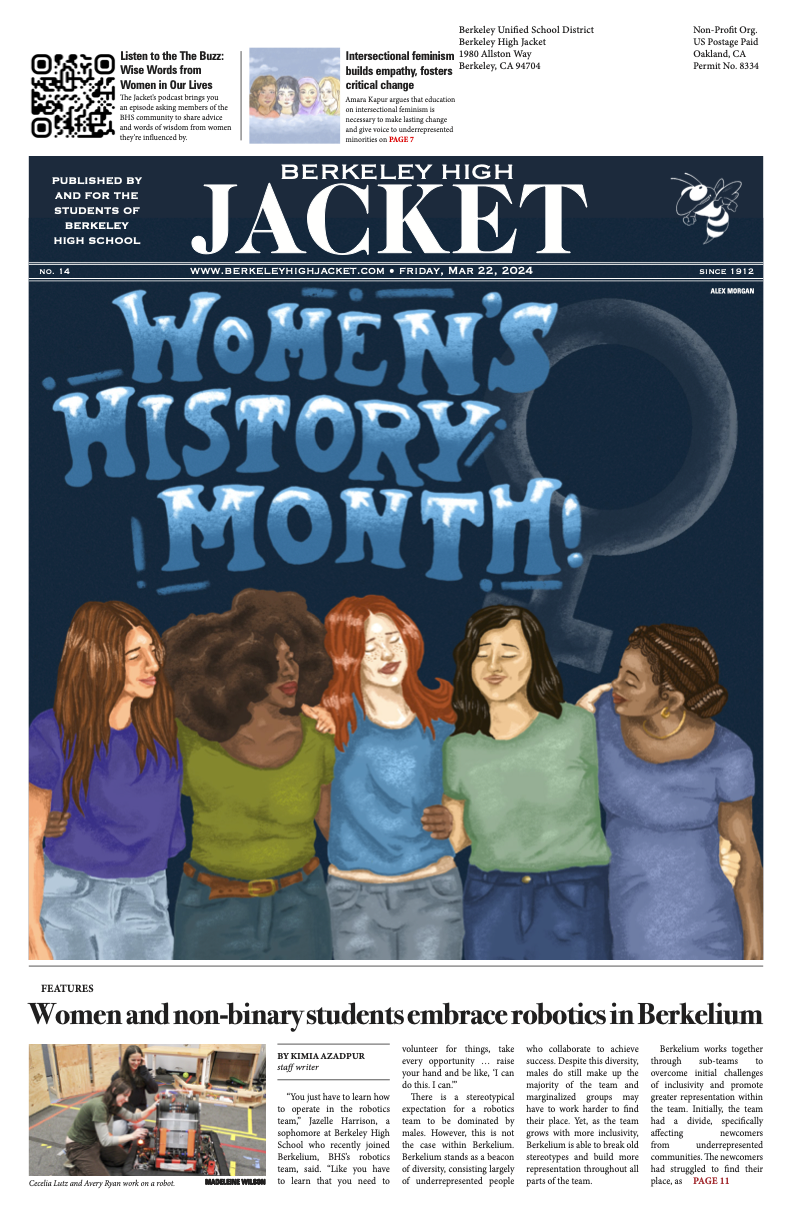

Berkeley High School offers many identity-based English classes including African American literature, Asian American and Pacific Islander Literature, Latinx Literature, and Queer Literature, all of which offer unique perspectives on culture and history through short stories, novels, and poetry. Nonetheless, there is one group that is noticeably missing from this list: women. “Females make up 50 percent of the population, and 50 percent of the population is deemed unworthy and deemed ‘less than,’” Kate Rosen, a BHS English teacher, said. Women have historically been shunned from writing literature and even when doing so, women had to write under male pseudonyms. For centuries, the writing canon has been dominated by white male authors, which leaves minorities — including women — unheard in the American public school system. While many English teachers include literature written by women, having a class that is specifically focused towards women’s literature would allow for students to explore the perspectives, stories, and history of women that have historically been overlooked.
Rosen, who teaches novels and short stories written by women in all of her classes, believes that having a women’s literature class would help expose all students to different perspectives that they might not otherwise encounter. “The beauty of literature is that it forces you to put yourself in someone else’s shoes, if only for a brief moment in time … (when you are) immersing yourself in women’s lit, you just become a more empathetic person,” Rosen said. Having a class that is dedicated to books written by women would help all students, regardless of gender identity, to learn about the beauty of literature through a feminist lens and get a new appreciation for the struggles that women go through in the past and present.
Ashley Cunningham, an 11th and 12th grade English teacher, believes that teaching a women’s literature class would not only support the female students of BHS but would help to educate non-female students on the harsh realities of being a woman in the 21st century. “We all as women have these collective experiences that are talked about in a piece of literature, like (in The) Handmaid’s Tale,” Cunningham said, “I think for my male students, it’s important for them to understand their positionality of where they’re at and how they view women, and how they approach women, and why (women) are in the position we are in.” Cunningham notes that the sensitive and sometimes difficult topics that are found in women’s literature are essential to discuss in order to fully understand the challenges that women face in today’s society. “It’s important to have these uncomfortable conversations because it also is just going to help you grow so much into a better human being, too,” Cunningham said.
It would also be important for a women’s literature class to include work by non-Western female writers. “I would not only like to see modern history books or modern books written by women, but also perhaps old ones or people from other countries,” Alegra Smith, a BHS sophomore said, noting how books that have been globally released by women have already made a significant impact beyond classrooms. “You can learn by reading books by Malala or other people (who have advanced) women’s rights and made it possible for (female voices) to be heard,” Smith said, “And by reading about it, we can learn more about other societies and other people and what their experiences are compared to us and how they differ.”
Although there would be concern over if students would enroll in women’s literature even though it is not an Advanced Placement class, having a class that is centered around literature about complex issues by women from all around the world would broaden understanding of the struggles that women deal with. Additionally, this class would allow for students to have a sense of connection to authors being discussed, something not being met in the majority of English classes at BHS. Ultimately, a women’s literature class would enhance the BHS English curriculum and allow students to gain a deeper understanding of the diverse experiences from women around the world.