

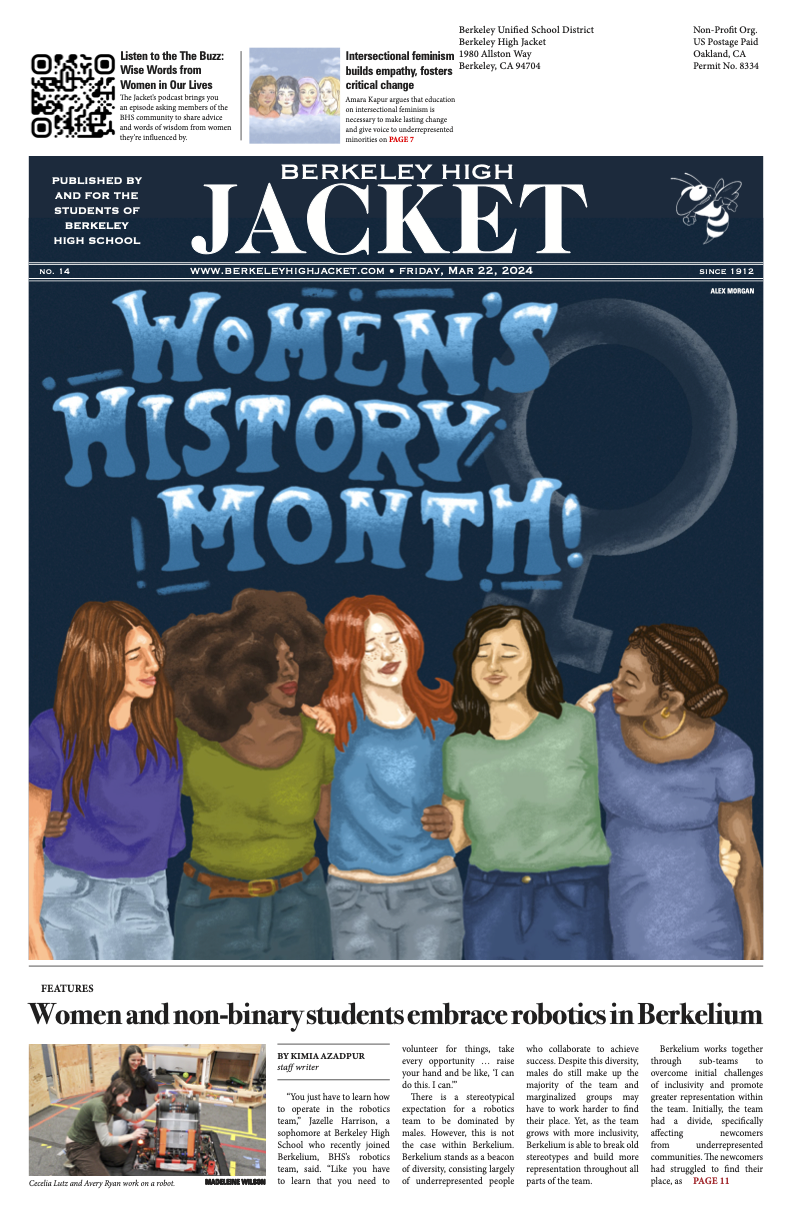

As conversations around gender representation continue to evolve, women across different fields are reshaping what leadership, expertise, and mentorship look like. At Berkeley High School, women in male-dominated, balanced, and female-dominated fields alike are not only navigating expectations, but actively reorganizing them, expanding opportunities and leadership for future generations.

For robotics teacher Elizabeth Buehler, her path into a traditionally male-dominated field began long before she entered the classroom. “I got into engineering first. So in high school, I started a robotics team,” Buehler said.
Now, in her classroom, she focuses on breaking down the confidence gap she often sees in students. “Male students tend to go in very confident … and I was like, ‘oh, I’ve never done any of that, will I be okay?’” Buehler said. That doubt led to an important realization: “I can do everything they’re doing.” Today, she works to instill that same mindset in her students.
Her impact is already visible in BHS’ robotics program, where girl representation is strong. “We have a robotics team … that is at least half women this year,” Buehler said.

In another traditionally male-dominated space, carpentry teacher Klea Bajala has experienced moments where her authority was challenged. When she first began teaching, she stepped in after another teacher left mid-year. “Students were banging on the table saying they were ‘team’ the previous teacher,” Bajala said. Despite resistance, she stayed focused on establishing expectations, particularly around safety.
Beyond student interactions, Bajala notes that pressure to prove herself extends into professional spaces. “Even with other teachers… if I make a decision on a build, people will wonder, ‘Is that going to hold up?’” Bajala said.

Even in fields that are not necessarily male-dominated, there are often still steps that need to be taken towards complete gender equality. Other women educators at BHS are making important strides in that direction. Principal assistant Monica Latour demonstrates how leadership and confidence can shape school environments, and hopefully move towards positive change.
As a principal assistant, Latour plays a main role in managing the school’s daily operations, a position that relies heavily on organization, communication and decisiveness. “I have a wealth of knowledge and great connections… so I’m very effective at what I do,” Latour said.
As a newer administrator at BHS, Latour remembers a specific instance in which her expertise was challenged. “Some people like to think, ‘I’ve been here 35 years, so I know,’ not realizing that things change and evolve.” Despite this, she stood firm in her experience.

In contrast, Linda Carr’s experience in a female-dominated field, dance, demonstrates how much gender dynamics can differ in different situations.
“We’re in a culture where men mostly don’t see dance as being for them, so I end up with mostly female classes,” Carr said. “I think that translates to girl power in my classes, because it’s mostly girls there.”
The experiences of female educators at BHS show that gender does not limit ability, leadership or success. Whether in male-dominated fields or more female-dominated ones, these women are challenging expectations and creating more inclusive environments.