

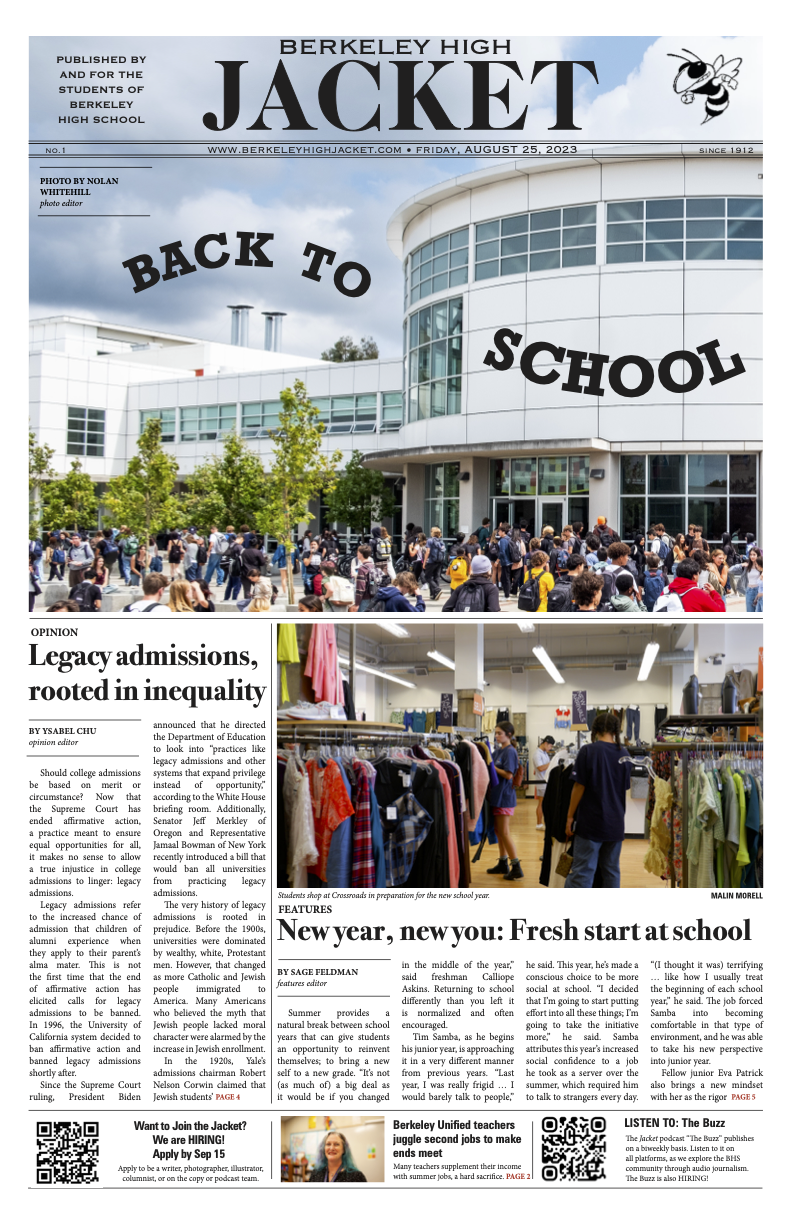

When Miriam Klein Stahl began helping create the Arts and Humanities Academy (AHA) at Berkeley High School in 2005, the goal was not simply to form another small school, but to rethink what education looks like for artistically inclined students. Now, as Stahl prepares to retire next year after 30 years of teaching, the community she helped build continues to alter how students experience learning, creativity and belonging. “AHA was designed to address the equity gap at Berkeley High,” Stahl said, “We viewed it not just as an achievement gap, but as an opportunity gap.”
In its earliest days, AHA emerged due to a realization among teachers: students were thriving in visual and performing arts classes, yet some were not seeing the same level of success in their non-art coursework. That disparity became the foundation for a new vision of education as a concept. “We knew our students could achieve across all disciplines, but they weren’t,” Stahl said, “That realization became the spark to create a school that bridges arts and academics.” Early conversations focused on reshaping how teachers saw their students; not as artists in one classroom and scholars in another, but as both at all times. “We wanted academic teachers to see their students as artists and bring out the best in them creatively, and art teachers to see their students as academics and bring out their academic potential,” she said.
Like the other small schools at BHS, AHA is built around a small learning community of about 60 students per grade, where teachers support students from sophomore year through graduation. The structure allows for collaborative teaching and interdisciplinary curriculum that connects subjects across disciplines. “Teachers constantly ask how we can support each student, whether they are struggling or thriving,” Stahl said, “We take responsibility for student outcomes and create engaging, interdisciplinary curriculum.”
AHA’s interdisciplinary focus was intentional from the beginning. Because the small school focuses on visual and performing arts, projects often culminate in public exhibitions and performances. Each year, students present their work at the Kala Art Institute, showcasing projects that combine their artistic expression with academic research. The experience is designed to evolve with students over time: sophomore year focuses on discovering identity as an artist, junior year emphasizes collaboration and senior year centers on contributing to society through creative work.
In the face of its success, establishing and sustaining AHA has come with challenges. One of the most persistent challenges has been communicating the meaning of equity in education. “Equity doesn’t mean equal, some students need more than others,” Stahl said, “There is often a perception that AHA is getting resources while others are not, so we constantly have to think about resources differently.” She also emphasized the ongoing need to advocate for the arts as essential to education. “The arts are sometimes not taken seriously and are seen as an add-on rather than essential,” she said, “Yet the arts are a huge part of living a happy and fulfilled life.”
Stahl has taught across all grade levels in AHA, and currently teaches juniors, seniors and a zero period class while supporting arts integration in freshman academic courses. For her, the most meaningful moments come from watching students turn dreams into reality. She recalled a former student who once spoke about wanting to work with Madonna. “He is now doing design and working as a makeup artist for her,” Stahl said, “It’s incredible to see students dream about their futures in high school and then live those dreams.”
Over three decades at BHS, Stahl has also witnessed profound cultural change. “I’m proud that we created a community where students feel safe, seen, and heard,” she said reflecting on the core foundation of AHA, “Being a teenager can feel isolating and we try to create a space where differences are celebrated rather than scrutinized.”